
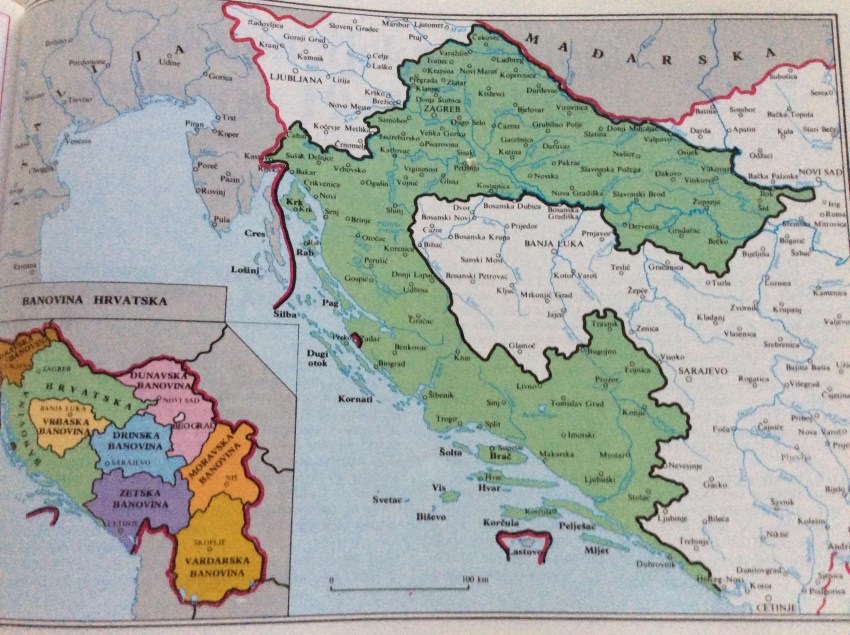
The assassination of King Alexander in Marseille in 1934 was followed by changes of government in Belgrade. Meanwhile, in Croatia, the national movement grew steadily under the leadership of the Croatian Peasant Party, which became the main opposition in the Belgrade parliament, and this unsettled the entire Kingdom of Yugoslavia. Faced with that situation, Prince Paul and the new government headed by Dragiša Cvetković decided in February 1939 to negotiate with the Croatian opposition.
Working together with Croatia’s Orthodox population and led by Dr. Vladko Maček, the Croatian Peasant Party set about solving the Croatian question. The Croatian side saw it as a solution to that question, while the Crown saw it as a possible way of keeping Yugoslavia going. The Cvetković–Maček Agreement was finalized on August 24, 1939, only a week before the outbreak of the Second World War.
On March 25, 1941, King Peter was put in place of the regent, Prince Paul. Although the purpose of this move was to deny or destroy Croatian independence, the approaching Second World War forced the Kingdom to seek Maček’s cooperation, and to grant even wider powers, such as the judiciary and the gendarmerie. In April 1941 the King and his government fled to London, and the Kingdom of Yugoslavia collapsed.
In exile in London, the prime minister of the royal government signed an agreement to cooperate with Tito. Ivan Šubašić, as Croatian ban, and Juraj Krnjević, acting for the vice-president (Vladko Maček), tried to preserve the Banovina’s borders after the war and to restore it.
The Banovina’s borders took in the regions where Croats made up the majority of the population.
Population of the Banovina:
| Croats | Serbs | Muslims |
|---|---|---|
| 3,061,680 | 847,005 | 174,150 |
| 75% | 19% | 6% |
Powers:
Dr. Maček named Ivan Šubašić Croatian ban. The Banovina took charge of agriculture, trade, forests, mines, construction, social policy, health, physical education, education and internal administration. Belgrade gave up most of the direct taxes. Elections to the Croatian Sabor were organized but never took place because of the war; only municipal elections were held.
Of note:
The Banovina had a fully autonomous judiciary, and no one but Croatia could influence it. An agreement was reached with the National Bank of the Kingdom of Yugoslavia for Croatia to issue its own money (the kuna or the banac). In April 1941 the gendarmerie brigade became, de jure, the Gendarmerie of the Banovina of Croatia, answerable to the ban alone.
Economy:
For all the ambitious plans, the economy could not make much headway, since the war was already in full swing.
Sport:
The Croatian Football Federation was founded in 1939. On April 2, 1940, Croatia played its first match as an independent national team, against Switzerland, and won 4-0.
Croatian Rowing Federation: founded November 4, 1939
Hockey, 1940: a 6-0 loss to Slovakia
Boxing Federation: founded October 5, 1939
Culture:
The so-called Croato-Serbian language was abolished. Stjepan Ivšić started the journal “Hrvatski jezik” (The Croatian Language). Work on the Croatian Encyclopedia, which had been interrupted, found support again in the 1930s and was resumed.
A campaign was started to improve the position of women and to give children better care and better health.
When the NDH was set up, the Banovina authorities simply placed the entire machinery of government at the new government’s disposal. At that moment the Banovina of Croatia had 140,000 gendarmes, who stopped operating after the Yugoslav units were disarmed.
Through all of this, Dr. Maček never dropped his demand that the other parts of Yugoslavia where Croats were the majority, such as Srijem, Banat and Bačka, as well as the Bay of Kotor, be joined to their Croatian homeland.
Sources: Dr. Ljubo Boban, “Hrvatske granice 1918-1993” (Croatian Borders 1918-1993)
Prof. Ivo Omrčanin, “Hrvatska 1941-1945” (Croatia 1941-1945)